
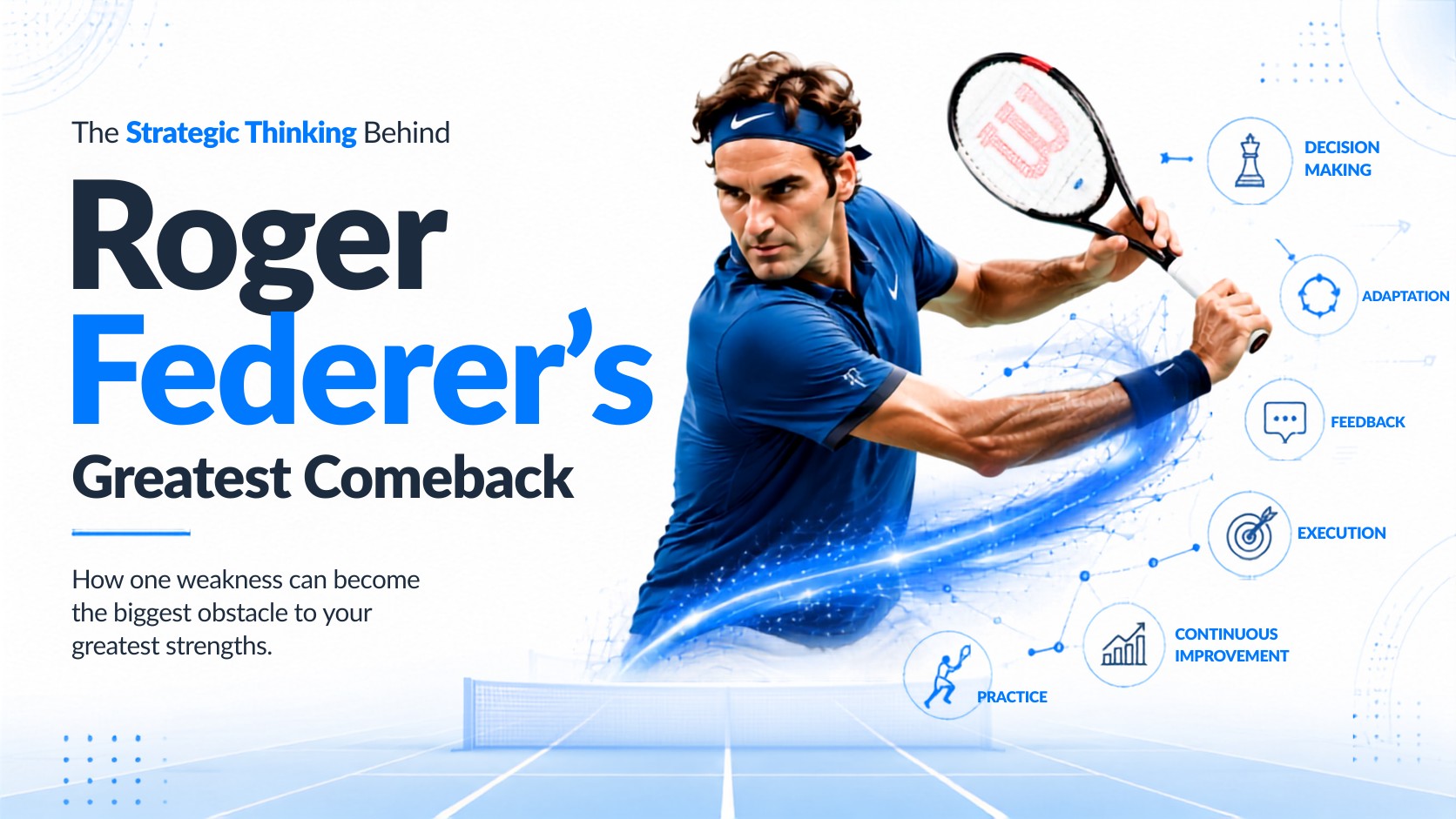
The Strategic Thinking Behind Roger Federer's Greatest Comeback
How one weakness can become the biggest obstacle to your greatest strengths.
What Federer's Backhand Taught Me About Growth
Early in my career, one of my most inspiring managers gave me this advice:
"Don't waste time fixing weaknesses. Build on your strengths, they will make you successful."
At the time, annual development conversations were about identifying weaknesses and fixing them. I liked my manager's advice much better. For example, being organized was never my strength, nor my priority. And I chose not to work on it.
That advice is insightful, but it misses something critical. The 2017 Australian Open final illustrates why.
The Weakness That Changed Everything
Roger Federer at 35, ranked No. 17, six months out from knee surgery, somehow found himself in the final against Rafael Nadal. Federer hadn't beaten Nadal in a Grand Slam in a decade, not since Wimbledon 2007.
The reason was no mystery. Federer's game was masterclass everywhere except one area, his one-handed backhand.
Nadal knew it. He would hit a high, heavy topspin into Federer's backhand and watch him either slice defensively or commit an unforced error. One weakness, exploited relentlessly, was enough to dominate a rival whom many considered the GOAT.
The Real Lesson in Strategic Thinking
That's the gap in the "just focus on strengths" model: weaknesses don't stay in their lane. The weaknesses worth your attention become a limiting force on your greatest strengths.
So the question isn't
"What are my weaknesses?"
The real question is:
Federer answered that question in the 2017 Australian Open. What he did next changed the course of the rivalry.
From Weakness to Weapon
Leading into that 2017 final, Roger Federer didn't work on his backhand to make it "less bad." He radically redesigned it into an attacking option.
He stepped inside the baseline to take the ball on the rise, replacing defensive slices with aggressive drives. In that final, he hit 14 backhand winners, several in the deciding games of the 5th set with Nadal, and won the title.
He turned it into a weapon.
Annual reviews usually ask leaders to pick 3 to 4 "development areas" to raise from below-average to acceptable.
I noticed that the leaders who truly pulled ahead weren't the ones fixing the most gaps. They were the ones who'd gone all in on a small number of things until those things stopped being skills and became identity.
Changing the Question
So I changed the question. Instead of "what should I improve this year," I started asking: Which one skill, if I became genuinely exceptional at, would compound everything else I do?
For instance, to build communication expertise, I spent 5 years, not a quarter. Observing, studying, rebuilding it dimension by dimension, the same way Federer didn't fix his backhand in a season. He rebuilt it stroke by stroke over months of dedicated training before it held up under Grand Slam pressure.
Two decades in, you'd rather be world-class at 6–8 core skills than "good enough" at 20. Being average across the board is invisible, but exceptional at a few compounds quietly, until it becomes an unfair advantage.
If you're planning your personal growth plan this year, don't build a list. Pick one, give it years, and aim to be in the top 10% at it.
Your Turn
What's the one skill you'd bet the next three years on?
Share your thoughts in the comments below. We'd love to hear your perspective.